
Trying for a Modern Appearance
Burnham seem to have had three attempts to produce pens of modern appearance. The first date back to the early 1950's at least. These were the unlikeable A series. They were apparently made to look as though they had hooded nibs but they actually had small tubular nibs.
The A-Series pens
There is little to say about these. Somewhere in the postwar years, around 1951 or earlier, Burnham introduced a series of pens with two-figure numbers and the prefix A, about 135mm. capped. These pens had barrels in solid colours, which looked superficially like moulded acrylic plastic, but in fact they were machined from rod, which is not acrylic, celluloid, or casein - possibly cellulose acetate. The same material was used for some conventional pen models. The sections were also machined, from black hard rubber. They had metal slip-on caps, with the vertical BURNHAM on the tabbed clip. The slip-on caps located on a plain circle of wire on the barrel. The plating of the caps didn’t last. And they had small fragile tubular nibs. The intention was probably to mimic the hooded nibs of more expensive competition, such as some of the Parker, but if so it was a pale imitation.
The A45 had a stainless nib, the A50, A59 and A64 had gold nibs. These pens have not survived well: I haven’t handled any except the A45 which is an unpleasant pen of inferior quality and looked it. The Burnham family have provided pictures of an A59 which is basically the same pen with a gold nib. I suspect that these pens didn’t sell at all well, and weren’t kept long either. The A45 with its cheap stainless nib appears in ebay occasionally but is neither collectable nor attractive. The main accomplishment of the A series may have been to compel Burnham to number some other conventional pens with a B prefix.
A45 and nib

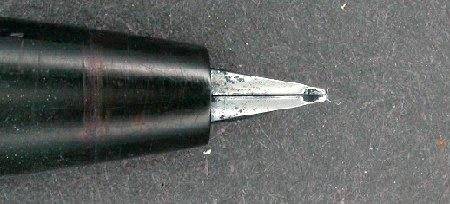
A45 and nib


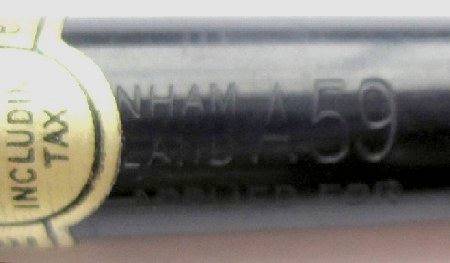
A59 pen and imprint
Pictures by Rodney Burnham
At some later stage - but I have no idea exactly when - there was another attempt to produce a modern pen, this time with a real hooded nib. Numbered No. 57, the solitary specimen is in the hands of the Burnham family. It may well be a prototype.
The Mysterious Burnham 57
Peter Burnham has provided pictures of a pen labelled BURNHAM 57. This is certainly not the pen referred to as No. 57 in 1954, priced at 10/6 like the No. 56. Although the mystery pen resembles A-series pens it is a much more expensive-looking pen and design detail is superior to the As. The pen has a genuinely hooded nib like many Parkers, and the cap snaps on to the barrel onto a purpose-made ring of metal, not a simple ring of wire as in the A pens. There is a metal-enclosed jewel at the end of the barrel. The imprint is not impressed into the barrel like other Burnhams, it is applied on to the surface. The pictures do not show any filling mechanism - is it aerometric or cartridge-filled?


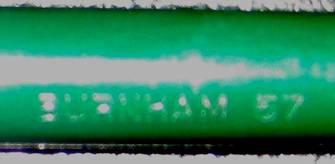
Pictures by Peter Burnham
The last Burnham pens, dating from the 1960's, were quite traditional in appearance although they were made in injection-moulded acrylic plastic and had an aerometric-style filling system.
The Acrylic pens
The last gasp of Burnham pen production, they must have been produced until the firm closed down in 1965-6, and may in a sense even have survived the firm’s demise. I haven’t got a starting date for these pens but it could have been as late as 1964. There is a Boots price list which the Boots Archive dated 1962-1964 which appears to refer only to the preceding generation of pens. The acrylic pens have little interest in relation to the traditional pens of Burnham and I can deal with them fully here.
The plastic components of the acrylic pens were injection-moulded (except for some feeds which were hard rubber as used in traditional pens) and the pens came only in solid colours. There were numbered models with gold nibs, and one un-numbered which used the screw-in interchangeable nib units of the older B48 model, with in many cases a surpassingly ugly moulded feed. The model with screw-in plated nibs and the model 59 appear most frequently in eBay auctions, and other numbered models are much less common. Other models known are 51, 55, and 56. There was also a Chatsworth version made for Boots the Chemist. The nibs of the numbered models correspond exactly in size with those of the same models in the previous generation, and the Chatsworth nib was a warranted version of the one found in the 51. The clip of the Burnham models was a tabbed version with BURNHAM running vertically and a model number, except that the model which used screw-in plated nibs was un-numbered. The Chatsworth clip was similar. These pens used a simple filler obviously based on the Parker aerometric system, reduced in efficiency by omitting the breather tube found in the Parker version. It was also reduced in durability, as Burnham used strange blue sacs which seem to have been a kind of natural latex which readily hardened, and also readily became fused to the metal filler mechanism by corrosion. There was a separate inner cap, something which Burnham had previously avoided using, and this was a polythene moulding. The caps were screw-on, and they had, rather indiscriminately, round, 4- and 5-sided tops (4-sided for plated nibs, consistently), and the width of the cap band increased with the size of the gold nib. Examples with price stickers show that the pens cost 7/6 for one with plated nib, 10/9 for the 51, 15/6 for the 55, 17/6 for the 59. These prices are the same as those given for the corresponding pens of the previous generation in the Boots lists for 1955-62 approximately - which makes the price of the Chatsworth 10/9 (like the 51) and 12/9 for the 56.
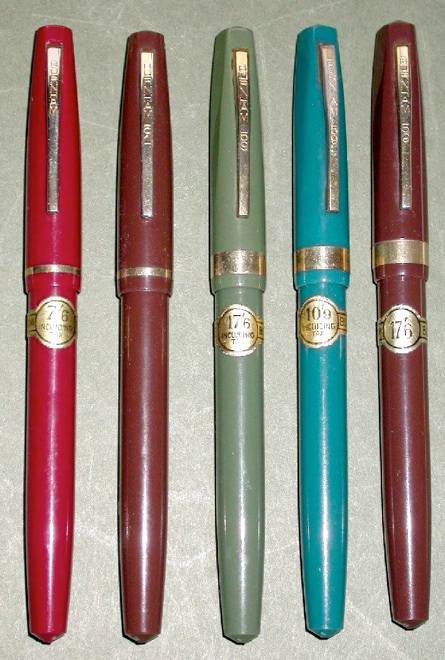


Acrylic pens left to right: plated nib, no number; no. 55, gold nib; no. 59, gold nib; no. 51 (price 10/9d and small gold nib give it away) with no. 59 cap (!); pen with no. 59 cap and price band for 17/6d – but it has a plated nib (!); no. 56 with small gold nib; Chatworth with small gold nib.
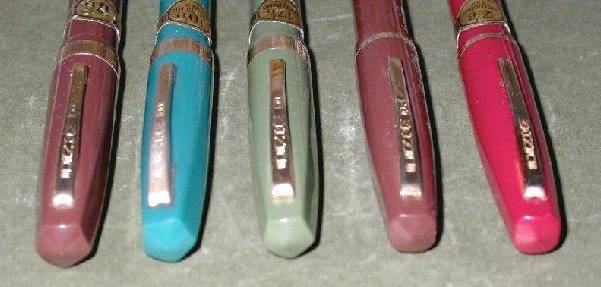
5-sided and 4-sided caps
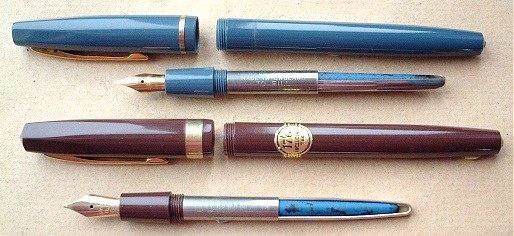
Pens unscrewed to access fillers.
Variation in the model 59 of the acrylic pens suggests that the organisation of Burnham was falling apart when they were made. We have (above) a mint model 59 with 17/6 price sticker..... and a B45 plated nib instead of a 14 ct gold one! Another (also above) with small nib and price 10/9d of a no. 51 but with a no. 59 cap; and another with the gold nib of a 59, but a 4-sided cap with plain BURNHAM on the clip, like the cap of a pen with plated nib, but bearing a wide cap band like a normal 59.
A lot of 7 assorted acrylic Burnhams appeared in an auction in 2005 and at least some probably were left-over prototype items from the Burnham empire. Among them were three which had stylographic nibs in two different styles, one which had a slip-on cap. Two were clipless. I have no evidence that any like these ever appeared commercially. There is also a mint and uninked clipless acrylic model in our possession, picture below the prototypes. It has an oblique cap top, and screw-in plated nib. Unaccountably this is a lever-filler with a black latex sac. It also might be a prototype. The auction lot is shown below, with also the clipless pen.
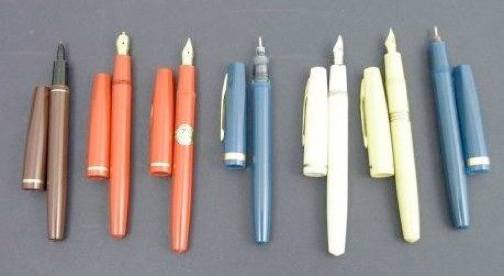

As writing implements the acrylics were of the same standard as other Burnhams, not surprising since the nibs were exactly the same.
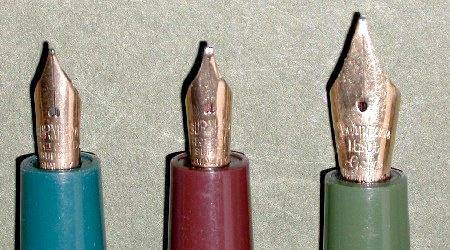
Nibs: L to R no. 56, no. 51, no. 59
Although efforts had obviously been made to bring their appearance “up to date” they were uninteresting in appearance, technically no advance, and in some ways mechanically less satisfactory than the traditional pens had been. The problems with the filler have already been mentioned, and also the clip tabs were inserted through two saw cuts in the cap and this was a very weak attachment, prone to break loose. Even mint examples can show cracking of the plastic starting from the cut.
The acrylic Burnhams may nevertheless have survived the demise of their parent firm. We have a pen and pencil set in which the pen is identical to the plated/interchangeable nib acrylic Burnhams - but where they are imprinted Burnham, it is imprinted Watermans. It has a synthetic rubber sac which is an improvement over the Burnham ones.
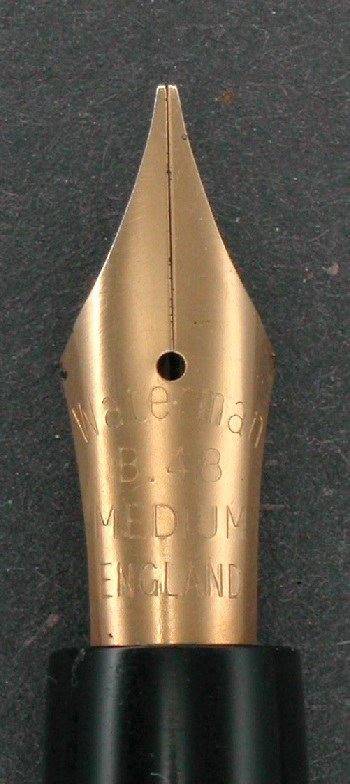

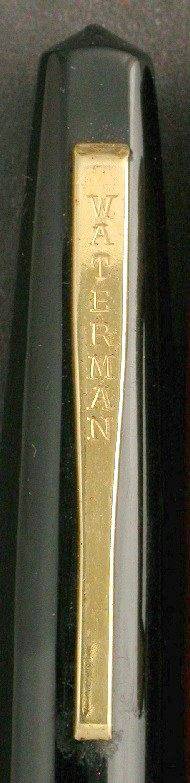
Waterman nib and pen
How did this pen come about? It has been revealed, through the researches of Steve Hull, that in 1968 William Burnham, one of Henry Burnham’s sons, became involved with the Waterman Pen Co. Ltd. Did he take the machinery and designs with him? Or did Waterman in fact make the acrylic Burnhams from the start?
Article © Alan Charlton 2011