
Pens with the imprint "The Burnham"
This is a diversity of pens from the 1930's and into the Second World War (and to some extent into the early postwar period).
PDF downloads are available here:
"The Burnham" - an overview............download here
The oldest "The Burnham" pens.......download here
"The Burnham" pens, late 1930's.......download here
"The Burnham" pens, 1939 on............download here
Ringtops...............................................download here
Gold pens.............................................download here
Vacuum-fillers......................................download here
“The Burnham” – an Overview
This is an area which is rather a can of worms! The first thing to point out is that some Burnham pen models show a “continuity of descent” which runs from pre-war “The Burnham” models to the post-war numbered models - and perhaps even earlier in the case of long slim pens in the no. 54 lineage. The most notable numbered pens here are nos. 44/49, 45-50, 54, 55, 60, and in many ways they show the major trends of Burnham pen development across the years. I have emphasized and discussed the continuity for these models in other sections of text with pictures of pens going back to the earliest types that could be involved. Unfortunately there are still a lot of pens from “The Burnham” era that don’t lend themselves very much to this sort of analysis and they just produce little more than a generalised picture gallery. There is also the problem that I have not been able to go into details of dimensions as much as I had intended.
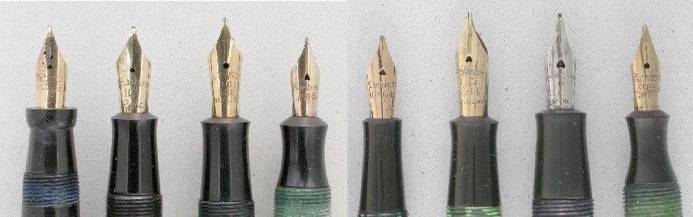
There are some features that seem related to time of origin in a very general way, though. The early 30s pens had quite “clunky” sections, but after this there was some diversity. Some sections of later large to medium pens are shown below with an earlier “clunky” section for comparison at extreme left. The larger pens all have the tidy outline which continued in a very similar vein in post-war years. The medium- sized pens, the mock baby duofolds and relatives, had a more curvaceous section (third from left). Smaller pens had at first slimmer versions of the curvaceous section (extreme right) and later they had slim versions of the section of the large pens. However it appears that, among the small elegant ringtops, the last form of section is restricted to one smallish size of pen.
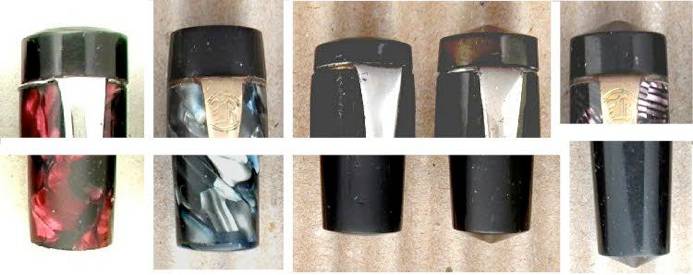
The larger pens are about the same sizes throughout the TB era and even through into the later numbered pen era, that is around 13cm (+/-) capped, and a less common version around 12 cm (+/-) capped. It is evident that there is so much minor variability in capped length throughout the period that it is unwise to use capped length as a very precise definitive measure. The large pens have the same slightly tapered flat-topped tassie – or occasionally a knurled larger tassie. The flat-top version goes as far as the 1939 advertisement, and after that we don’t have a precise date, but it was replaced by a tassie with a similar side profile but with a low conical upper face. These features are shown in the sections on nos. 45-50 and 60 particularly. Basically they continued until the form of the pens changed in the early post-war
years. The barrel end was flat or very nearly so, right through until the post-1939 pens when it acquired a low conical profile instead of a flat end. Exactly when the low conical profile was adopted, in place of the flat ends, is shrouded in the obscurity of wartime. The earliest actually dated pen we have with conical profile is boxed and has 1943 written on the box.
Tassie and barrel ends. L to R: 1930s “mock baby duofold”; late 1930s flat ends; two pens of the same model, from late 1930s with slightly rounded ends at left and post-1939 with coned ends at right; post-1939 coned ends.
Filling levers with the stamp “BP” are found on earlier pens, and a Gothic B in a circle on later ones – see chapter on Levers. The earliest confirmed date we have for the circled B is 1935. We can add that the BP stamp seemed to persist much longer on small and particularly ringtop pens. The Gothic B occurs on clips of the larger pens through much of the period and then the B in a diamond cartouche takes over in the larger pens.
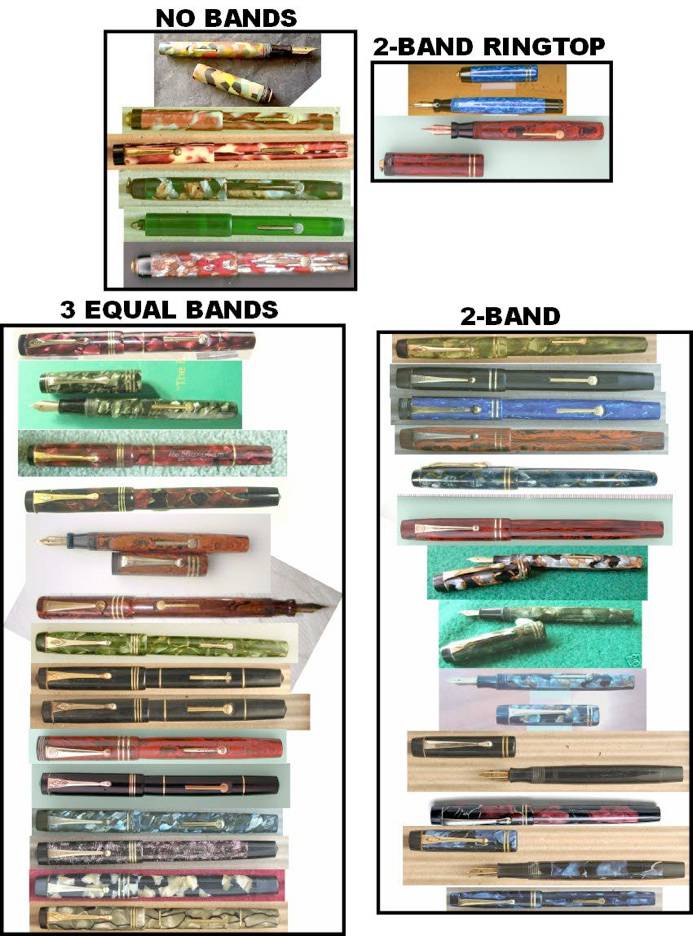
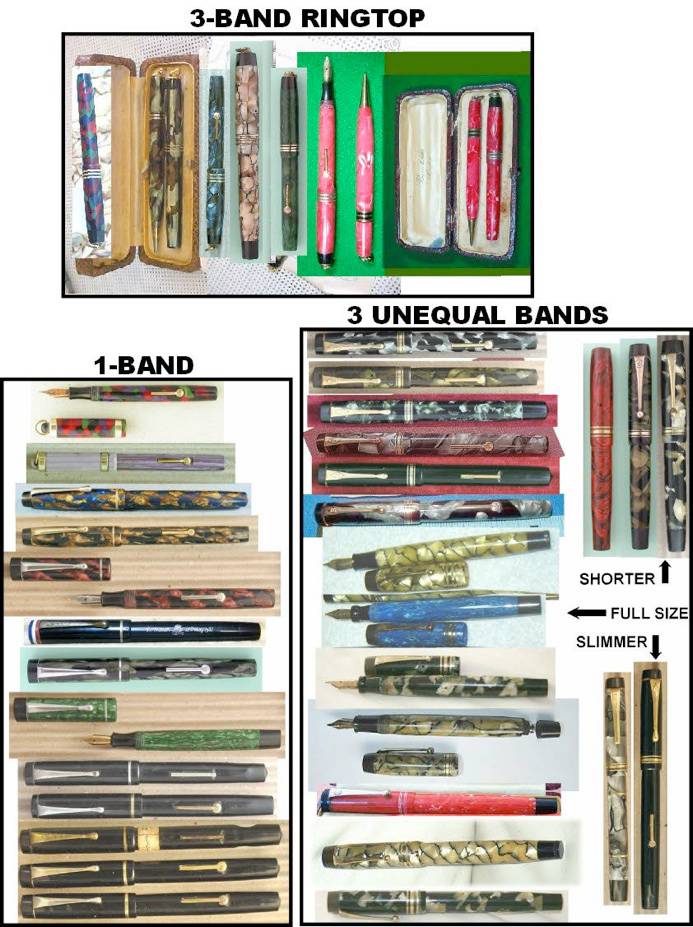
In ordinary pens with clip caps there are variations which correlate directly with stature, to some extent nib material, and presumably price. As we go up the scale of size the number of cap bands increases from 1 to 3, and then at 3 cap bands there are pens with 3 equal bands and pens with 2 narrow and 1 wider band. For a given size of pen, at least in the smallest pens, a steel or stainless nib can be associated with a single cap band and a gold nib with 2 bands. In the larger pens it appears that larger gold nibs go with 3 cap bands rather than 2.
A number of composite pictures follow which give a very general idea of the variation during the TB period, divided up by number and diversity of cap bands. Obviously there would be enough material to produce a coffee-table book of pictures of Burnhams but I have not tried to do this. That would be a job for a serious collector!
The older-style section TBs
Pens imprinted “The Burnham” are called TBs for short. Some have the clunky form of section found in the later BP3s (well, I assume they’re later) but these versions are comparatively rare. The lever, if present, is invariably one with the BP logo. It is quite noticeable that these pens are often identical in general form with TBs with the later sections. There are full-size pens, about 13 cm capped, and smaller pens including ring- tops and a clipless. Some of these are shown below, with scale where available.
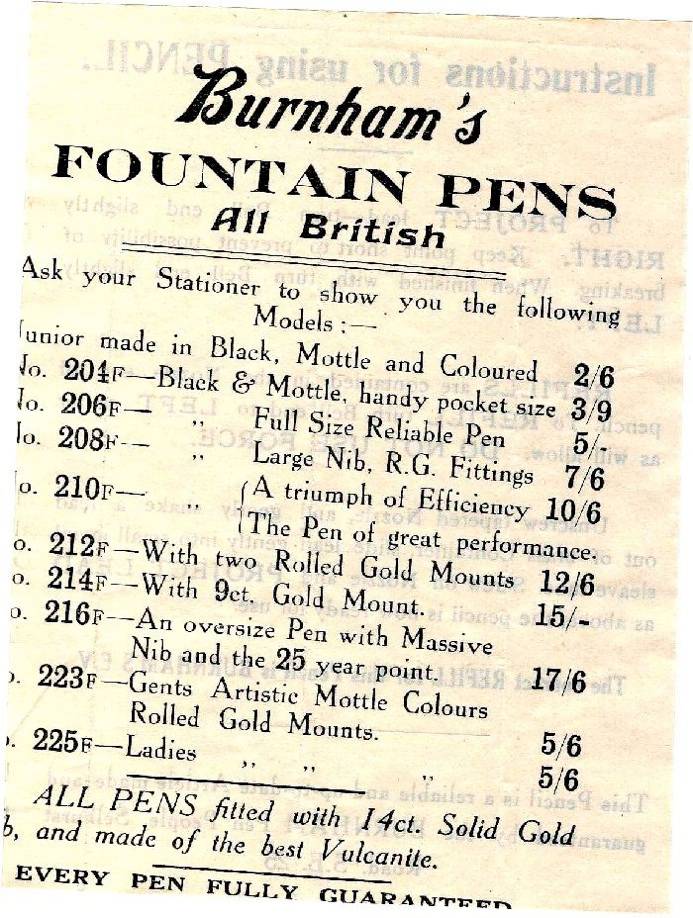
As with most Burnhams, the dates are problematical but basically they are between 1931 (Steve Hull’s date for introduction of button fillers) and 1935 (the earliest actually dated pen we have imprinted “The Burnham”). An instruction sheet which came with one of the pens, the second down in the picture of 4 capped pens below, claims “ALL PENS fitted with 14ct. Solid Gold Nib, and made of the best Vulcanite.” If this is true, the multicolour pens shown below are presumably later than the red ripple ones, since they are celluloid or casein.
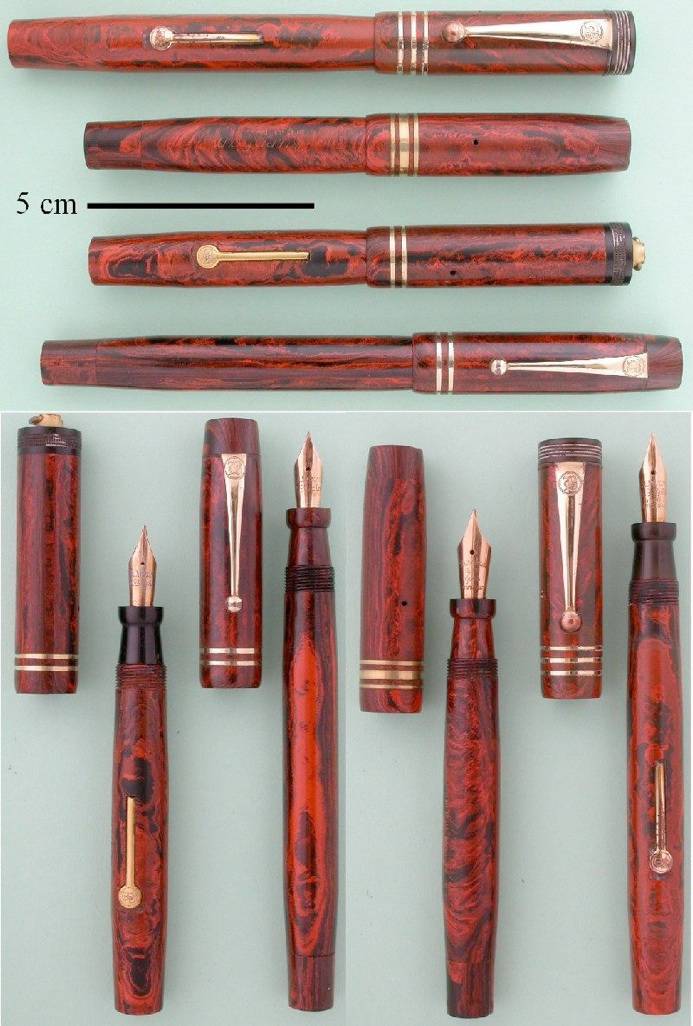
Larger examples in red ripple hard rubber (Vulcanite). Ringtop imprinted "Ariel"
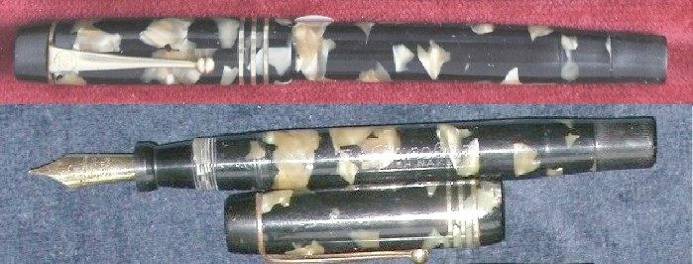
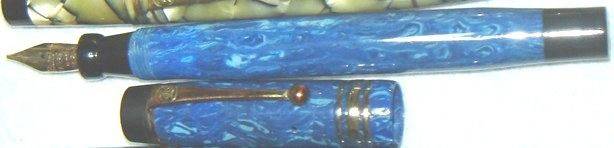
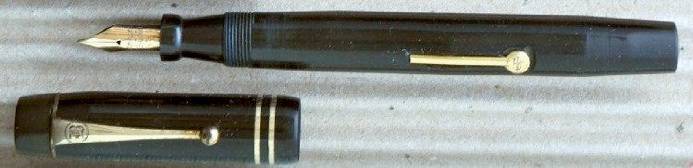
Larger examples
In celluloid (upper) and casein (lower two) All about 13cm capped
Long slim, casein

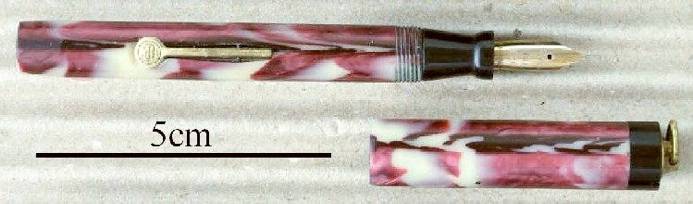
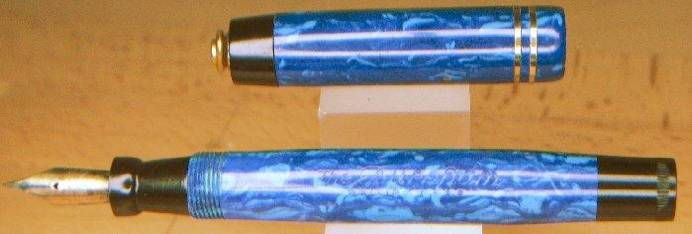
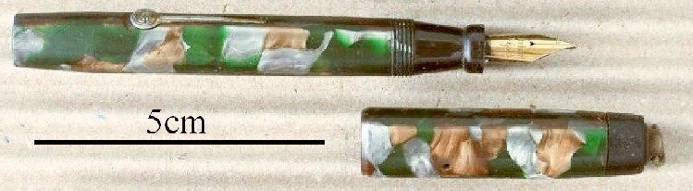
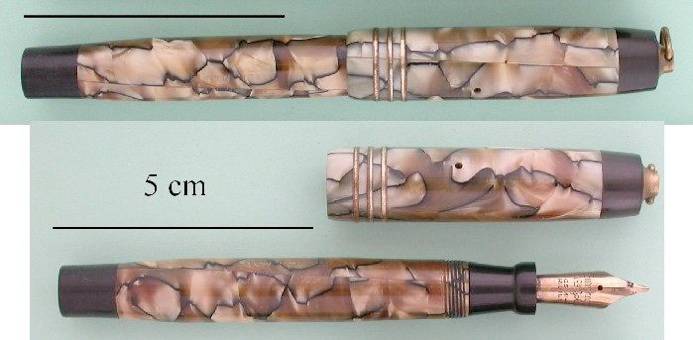
Smaller ringtops, all casein except the lowest. The next lowest is particularly interesting as the same material appears in some post-war pens too.
“The Burnham” later 1930s
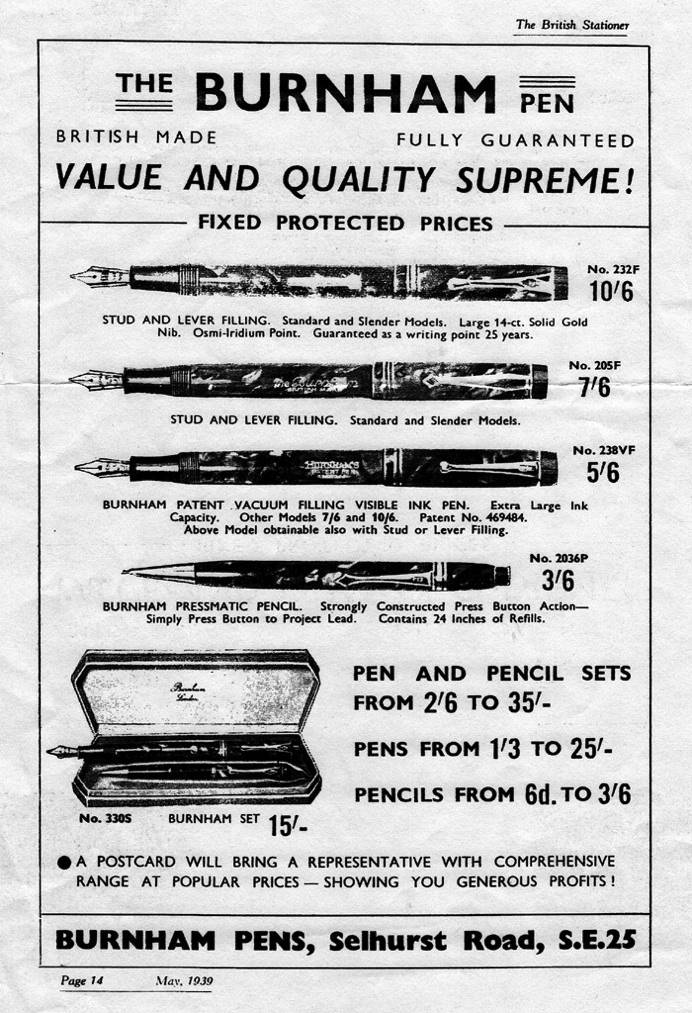
These pens are a part of the TB collection. They are often identical in general form with TBs with the earlier “clunky” section. As with most Burnhams, the dates are problematical but basically they are from about 1935 (the earliest actually dated pen we have in this complex) to 1939, the date on the latest documented flat-topped material. The document is actually a photocopy of an advertisement dated May 1939 (in Steve Hull’s possession).
Advert from the British Stationer, May 1939
The clip is a plain teardrop quite commonly; if imprinted it’s almost invariably a ball-ended one with the gothic B logo, occasionally a teardrop with the B in diamond cartouche, or a spade-ended form. All these are shown in the 1939 advertisement. The lever is invariably a lollipop form, with the gothic B logo (possibly occasionally a BP imprint). The pens are flat-topped and with flat barrel ends, except the group we called the “mock baby duofolds” which have a very slight domed effect on the tassie, so there were two consistent styles at this stage. The cap is elegantly tapered lightly toward the top in most cases, but it is parallel-sided in the mock duofolds and in any pen which has a large knurled tassie (e.g. pen 16). The pens have an elegantly-shaped section, more curvaceous in the “mock baby duofolds”. It seems probable that the baby duofolds were transformed into the tapered standard form at a late stage.
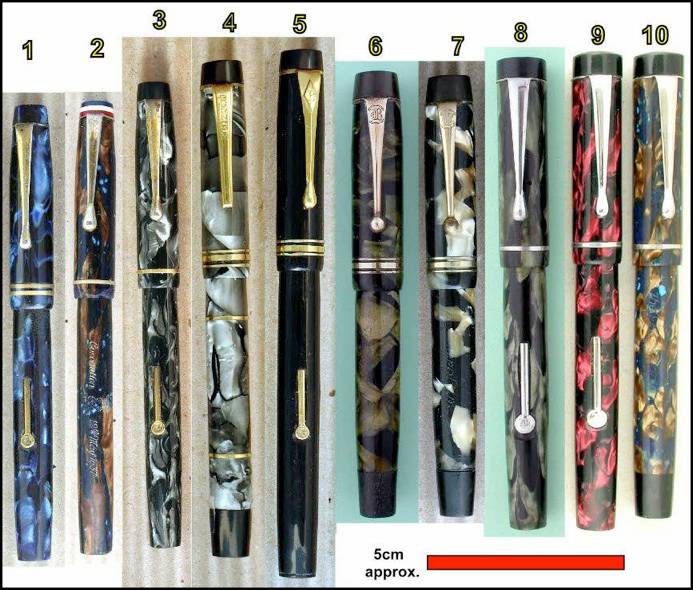
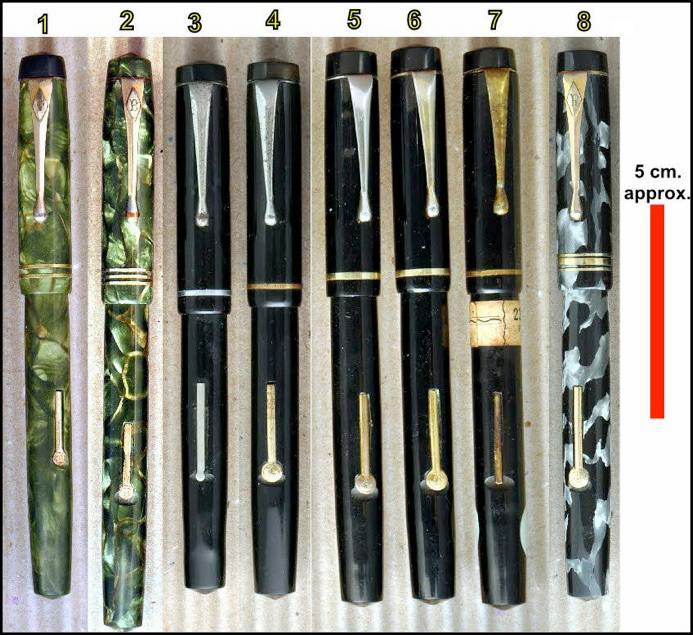
There are full-size pens, about 13 cm capped, and smaller pens including ringtops. The ringtops are covered separately. Some of the pens are shown below, with scale where available. They fall into 3 divisions of barrel diameter – 1-3 the slimmest, 4–5 the middling ones,
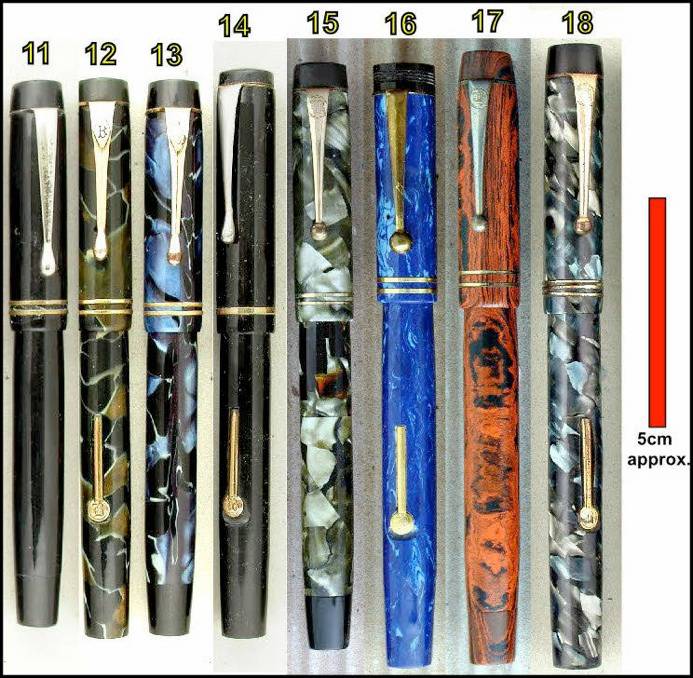
and 6-18 the standard thickness. Apart from the small slim pens 1-2 and the short full thickness pens 6-7, it needs more than a passing glance to notice variations in length unless the pens are put in order as they are here. The mock duofolds and their relatives, 8-13, form a group of slightly shorter pens, and there is a slightly longer class 15-18 which probably includes the more expensive pens. Pen 11 probably represents an intermediate stage between the mock babies 8-10 and the 2-band pens 12 and 13, as the barrel is identical in them all and the only differences occur in cap and section detail. Pen 14 sits uncomfortably at an intermediate length in between 8-13 and 15-18, and perhaps emphasizes the point that quality control in those days was not all it might have been!
Pens shown on this and next page... Note no. 4 probably has a later replacement clip. No. 15 is a vacuum-filler.
“The Burnham” ?late 1939 to early postwar, ?1946
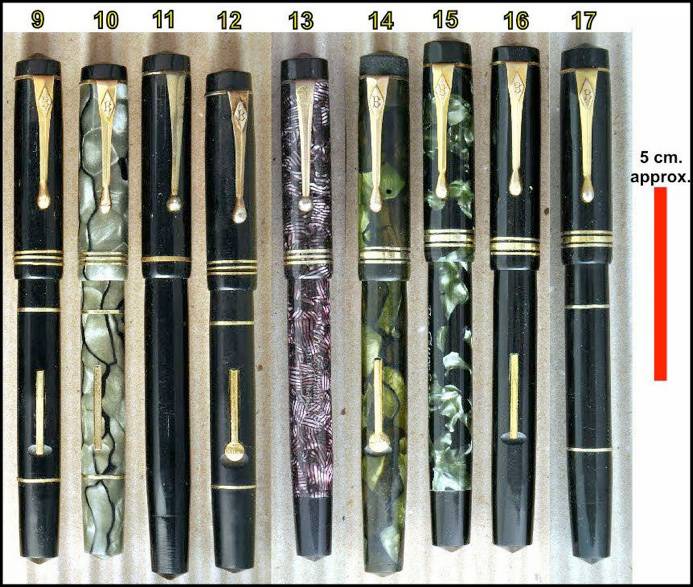
More of the TB collection...... Although I’m giving late 1939 as the starting date the earliest dated pen we have is 1943. The end date is determined by the introduction of the 2-figure number series which seems to have been 1946. However, as will be seen from the model descriptions, some models retained the older form at first even though they acquired the new numbers. This happened with 2-figure nos. 55, 60, 65 at least. Some of the pens shown here are actually very early numbered examples; nos. 9 and 11 are no. 65. No. 11 is very “economy” and has a cap with reduced number of bands and a ball-ended clip.
The clip is a plain teardrop quite commonly on what are presumably the cheaper smaller models; the larger more expensive ones generally had a teardrop with the B in diamond cartouche. The lever is a lollipop form in many pens, with the gothic B logo; in many later pens the lever is straight and plain. The cap and barrel ends are apparently always slightly tapered, and the tassie top and barrel end surface have a moderately conical profile. Ringtops are not specifically identifiable, see section on ringtops.
In this group, so far, all the pens known are full size, up to 13cm capped or so. Pens 1-2 are a slightly slim variety compared to the others. No pens have been seen comparable to the smallest and slimmest ones in the previous group (pens 1-3 in that group’s pictures). I find myself wondering if the flat-top version of these smaller pens continued in production and was not replaced until a later era. It has to be borne in mind that the late 1939–early postwar group probably began life during the “phony war” of 1939-40 and further developments at the time were stopped by the intensifying war. Certainly there seems to be a rather comparable, but more drastic, situation with National Security pens - the production of National Security pens was apparently completely terminated in 1940.
Quality was very variable, probably correlated with the state of wartime and postwar shortages at manufacture. The pens 3-4 are model 208F which is often particularly bad quality, often with signs of shortages such as sunburst levers which were probably bought in. The casein pens of this model are often crazed and have occasionally become so brittle they have broken up.In the case of pen 3 the lever is definitely not Burnham. Pens 5-7 are 232F and these are also often of poor quality. Nos. 5 and 6 have lollipop levers so are probably earlier than 7 with its plain lever. Pen 9, as remarked, is actually imprinted No. 65, and is definitely poor quality casein, somewhat shrunken and surface crazed. Pens 10 and 12 are the same model, imprinted “The Burnham” so are earlier, but are better material. Pens 13 and 15 are celluloid and feel pre- war quality. Pens 16 (model 15F), 8 and 17 are casein but in good condition, while 14, dated 1943, is casein and well-crazed – it has been re-polished.
Ringtops from the 1930s
Ringtops start with the “Best Possible British Production” era, the BP3’s, and continue to the end of the TB collection. Once we enter the post-war era of the 2-figure number pens ringtops are essentially nonexistent, and the odd one recorded, a No. 56, likely is a prototype rather than a commercial production. The earliest ringtops have the same “clunky” section as some BP3s and the early“The Burnham”. As with most Burnhams, the dates are problematical, but basically they have to be from the very early 1930’s to the early war years, probably ending with the “phony war” in 1940.
When I composed the section “The older-style section TBs” I included related ringtops. Now I feel that assigning ringtops to a period is more uncertain than for ordinary pens. Partly this is because there is relatively little variation in size – 4 main sizes only (below) – or in style. Also I think that style was not very tightly tied to time of manufacture.
The multicolour green/orange/silver ringtop shown in the section “The
older-style section TBs” is a very relevant cautionary example here. It is made in a plastic which looks late 1930’s, not early, and even occurred post-war. One might even suggest this pen is a late production...but the clunky section and the BP lever together tell us that it’s most probably an early 30’s pen.
There is the general impression that the largest pens with clunky section are oldest, the smallest and the medium ringtops are the mid- period, and “small” are the latest.
So on the whole ringtops don’t have much to offer in the “evolutionary” sense; they are however pretty collectables. And we have one early ringtop which is definitely made of a version of celluloid very uncommon in Burnhams, or indeed other UK-manufactured pens. That is celluloid made with a longitudinal seam, not the common spiral- wound version. Most likely it’s celluloid imported from the USA
Pictures on next page:





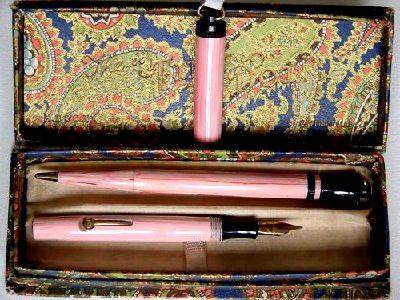



Tiny Dot boxed set
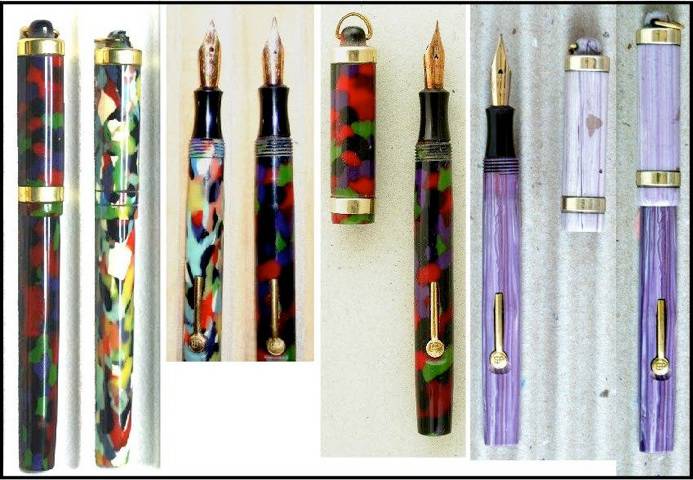
Smallest ringtops, about 9.5 cm. long capped. Sections are all the “curvaceous” form. All have BP lever. Some or all of these would have been sold under the name “Tiny Dot”: a complete boxed set, pictured below the group picture, was sold recently on eBay.
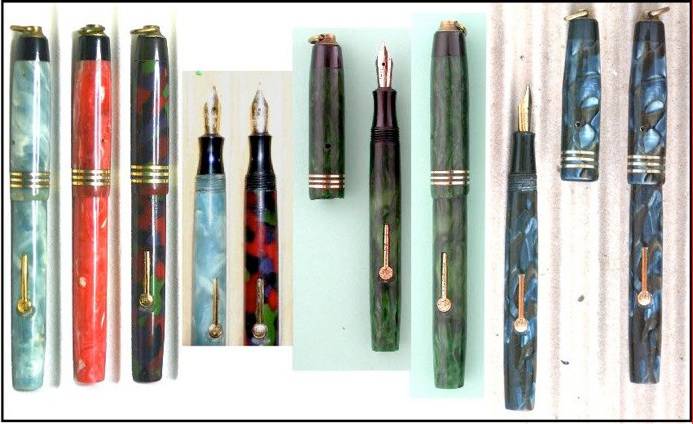
Small ringtops, about 10 - 10.5 cm. long capped. Sections all the “curvaceous” form except the extreme right example, which has the standard form that continued well after the second world war. The pastel blue, at left, and the 2 right-hand pens, have levers with gothic B. The other 2 pens have the earlier BP lever.
Medium ringtops, about 10.5 – 11 cm. long capped. The solid green pen (actually a Burnham Junior) has the curvaceous section, all the others are “clunky”. All have the BP lever.
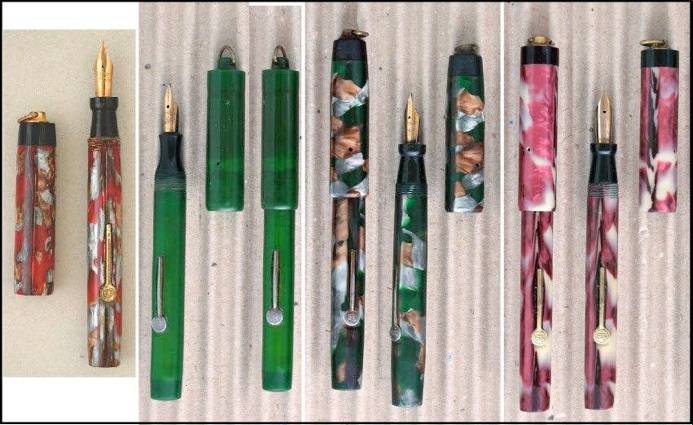
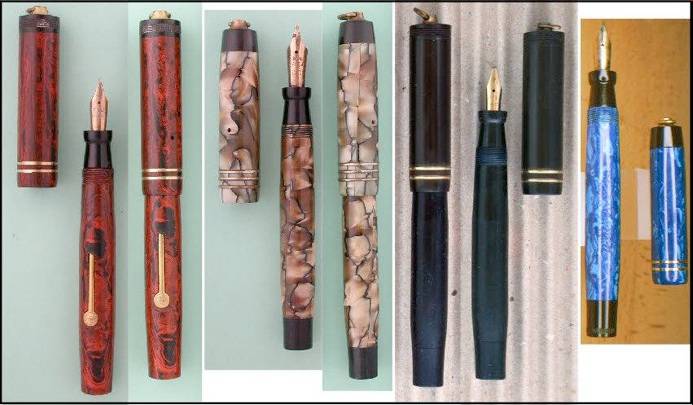
Large ringtops, about 12 cm. long capped and a little thicker than the medium ones. All “clunky” sections. BP lever on the extreme left, others button-fillers.
The Gold Pens
Only two styles of gold pen seem to have been produced, both button fillers in the same standard size approximately 13 cm. capped. One is in a checkered rectangular design, and one in a “barleycorn” design. They show a variety of clip styles and one is clipless, but they are all flat-tops of the style current up to 1939. Rather few must have been sold as they have been very uncommon in the market. Some specimens survived in the possession of members of the Burnham family until the 2000s or so and some are still in family possession.
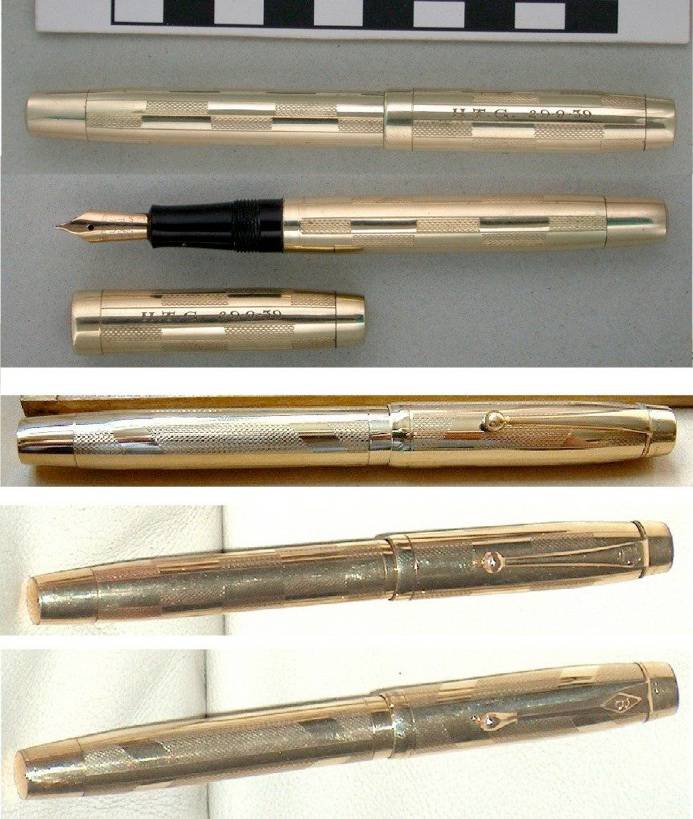
Top to bottom: Clipless pen with checker design, engraved and date to 1939; barleycorn design with plain ball clip (Barry Rose); checker design with B in circle on ball-end clip; barleycorn design with B- diamond teardrop clip (last two Akiva Gordon pics.)
The Burnham Vacuum Pen
I think it was Frank Dubiel who commented that there were a lot of Mad Scientist pen designs from the 1930's. The statement is correct, whether Dubiel made it or not. The Burnham Vacuum Pen is definitely one of those designs, and what is more, I suspect that it was cribbed from Wearever’s Mad Scientist design (bearing their Pioneer brand name) which had about a 2-year start.
It was described in the 1939 advertisement as BURNHAM PATENT VACUUM FILLING VISIBLE INK PEN. There were 3 models, 238VF, 244VF and 246VF, starting at 5/6d for the 238VF. Burnham can’t have had total confidence in the thing since they said “Above model obtainable also with stud or lever filling”. The 238VF is shown here:
The Burnham vacuum pen looked like a button-filler with the barrel divided into a lower semi-transparent part and a non-transparent upper part. The pen bears the patent number 469484. The specification is (in theory at least) downloadable from the Patent Office and has the application date Feb. 14 1936, with final acceptance July 27 1937. The specification for the Wearever patent (1966369) was filed Feb. 13 1934 and granted July 10 1934. These pens also came with Wearever’s trick nib, a thin gold part in a stronger stainless steel corset, and they appeared with these inscribed “Pat Pending”..... that patent (1989220) was filed in Feb. 1934, granted in Jan 1935. Burnham therefore had nearly 2 years in which they could have obtained and dissected a Wearever vacuum pen.
Drawings from the patents are reproduced here (following pages).

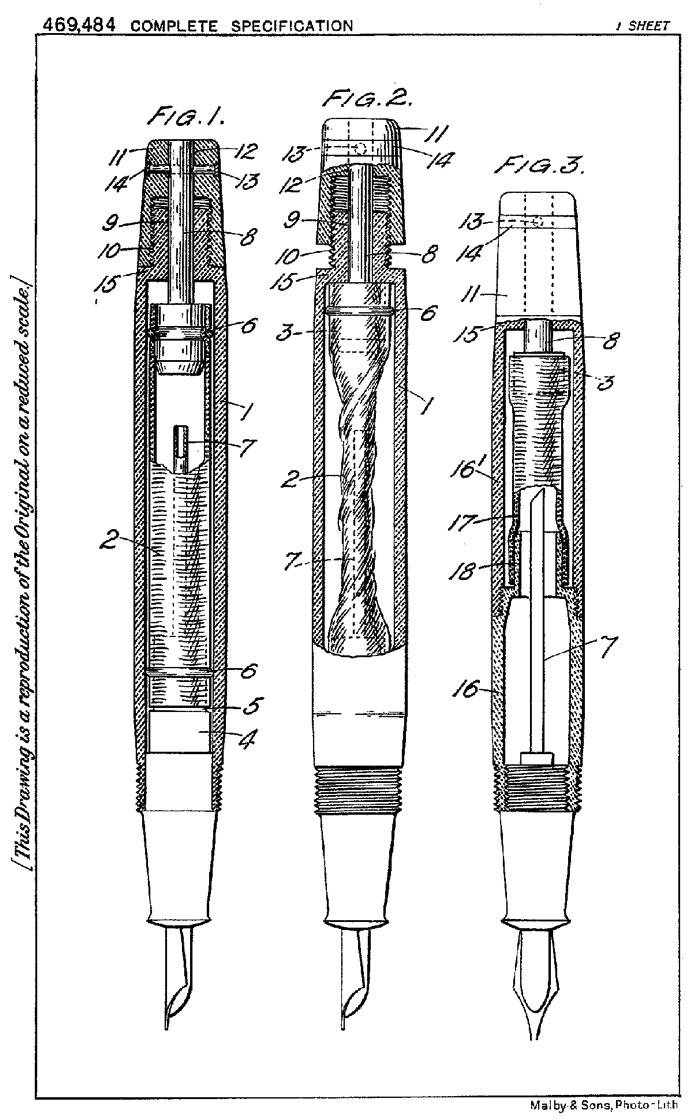
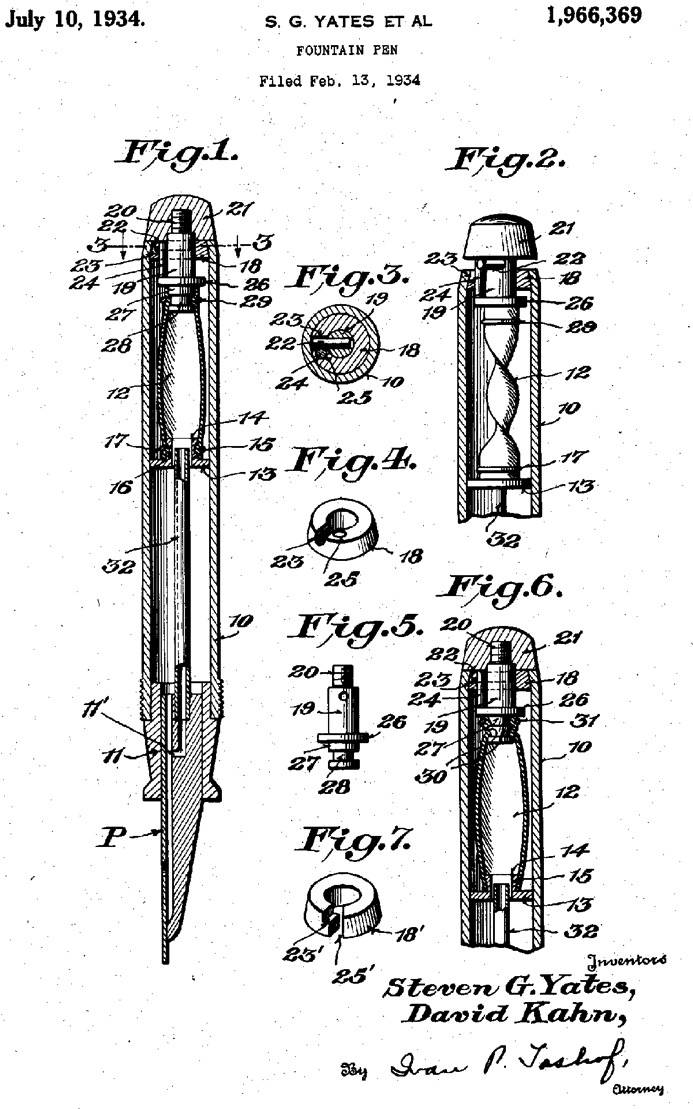
In both pens as made there is a lower ink reservoir with a breather tube passing through from the feed to an upper chamber in which there is a rubber sac or tube. The sac is attached to the bottom of the part that looks like a blind cap in the Burnham or a knob in the Wearever. The pen is filled by turning the knob or cap to twist the rubber and expel air via the breather tube, then releasing the cap allows the rubber to untwist and draw ink in through the feed and up the tube. The travel of the knob is restricted by a pin mechanism in the Wearever, but by limited movement along a screw thread in the Burnham. This is all very well, but are these practical pens?
As shown in the patent drawings, the Wearever version has one major snag - when the rubber perishes it will be a major pain to replace it. You would probably have to drill out the twist assembly, for one thing, and then the nipple for the lower end of the rubber is inaccessible halfway down the barrel. This probably wouldn’t bother Wearever, their pens were made for a short life and a gay one.
The Burnham version, as built, was quite like Fig.3 on their diagram. (Their Fig. 1 and 2 were not made; they resemble the twist-fill Sheaffer Wasp pens but with the addition of a breather tube and a more complicated twist knob). But that drawing shows a pen which can be unscrewed into its component parts for maintenance, and the twist-knob removed by punching out a retaining pin which is normally concealed by a metal band. The model 238VF when dissected is actually much more problematical. The joint in mid-barrel is not screwed but cemented, and the twist-knob is cemented onto its shaft. Consequently it is basically unrepairable in its original form without drilling out the old parts and then using a number of replacement parts. Actually the mechanism can be restored with a little misuse. The barrel joint can be worked loose with gentle persistence, remains of rubber cleared out with a probe, and a new rubber can be fitted by using a short rubber sac with a complete end, and supergluing the closed end of the sac to the twist mechanism. To do this adequately it is necessary also to remove the section (or at least the feed) so a rod can be used to push the sac end up against the twist device. When complete - as a filling mechanism it works pretty well, even though it’s a nightmare of a design.
No pin is used in the 238VF to retain the twist knob, but it seems likely that the larger models were made with a pin retainer, since they do appear to have had the metal band that Burnham specified should be used to conceal the pin in the knob. The pens shown below seem to be the 244VF and fancier 246VF (black). The black pen pics by Akiva Gordon.
Consequently these models might be easier to restore than the smaller ones. Whether because of the repair difficulties or because they simply did not become popular, very few of any of the vacuum-fillers survived.


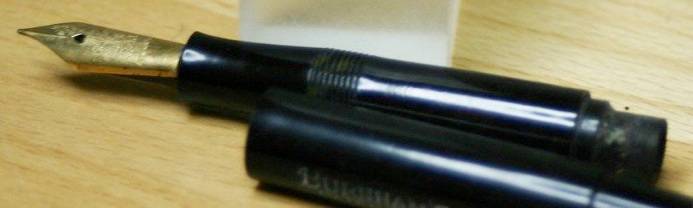
The barrel of the 246VF (at least) was cemented like the 238VF rather than the sections screwed together as the patent showed so this would not present too much problem.
A recent picture from Akiva Gordon shows what looks like a top-of-the-range model which does not have the pin retainer and I suspect this is a procedure to cheapen manufacture.
Article © Alan Charlton 2011